History Carnival 101 for August 2011

Oh dear. Based on the fantastic assortment of history blogging that was nominated for this August’s History Carnival, I’m afraid there’s not much hope of disproving the cliché that historians are pasty, fidgety creatures who’d much prefer to be huddled in a library or at a computer than out enjoying the summer sunshine. On the other hand, there’s considerable hope for proving that the summer sunshine is highly over-rated, and who needs to pack off to a beach anyway when we can be transported to the amazing worlds revealed by these extremely industrious history blogging goblins? More power to you, fellow creatures of the gloom!

In case you don’t know, the History Carnival is a monthly round-up of the best in history blogging, which has now been running for over a hundred installments. This month, my very first recommendation to you is to check out the Carnival’s web site, which, with its archive of every past Carnival, is a jumping off point to enough historical good stuff to fill a lifetime’s worth of summers.

—-

- If, like me, you spend way too much of your time thinking about being in Paris but way too little actually being there, the first two blogs could be a much needed tonic. Parisian Fields is one of my very favourite blogs on the city for reasons that this post, a great piece of detective work based on a postcard the writers accidentally found, amply demonstrates. Small, seemingly trivial details are spun out bewitchingly into great tapestries that post by post tell the story of the city itself.

A postcard showing a now lost Parisian building – the subject of Parisian Field’s post A palace of commerce and a 1904 rendez-vous.

- While we’re talking about overlooked details, they don’t come much more overlooked than Stephen Sauvestre. Though Gustave Eiffel has gone down in history as the creator of the tower that bears his name, Sauvestre was responsible for adding the beauty and elegance to what had previously been a functional design, without which the Eiffel Tower simply would not be the Eiffel Tower. This terrific post on Invisible Paris examines some of Sauvestre’s other surviving buildings in Paris, which you would probably never connect with the architecture of the tower, but which are nonetheless strikingly individual buildings in a city often denigrated for its uniformity.

- More hidden treasures are unearthed at Madame Guillotine’s saucepot of a blog. Unusually, this post finds her not swishing around Versailles or fan-fluttering through Paris, but at 18 Folgate Street in Spitalfields, London. This house is one of London’s most beguiling oddities: the creation of artist Dennis Severs who set out, as Madame Guillotine puts it, “to transform the house into a living time capsule of various different periods in the district’s history”, with the feeling that its occupants of different eras have simply stepped out of the full-of-life rooms moments before you step into them. I defy you not to want to visit this place after reading this post, and seeing the sumptuous photography.

18 Folgate Street, by Madame Guillotine.

While I’m on hidden London gems, this post from the Two Nerdy History girls on obscure survivors of the once magnificent Northumberland House is typical of their interesting and prodigious output (and they always come up with the historical goods on twitter).

- More insights into the physical world of people from the past come from another of my favourite blogs – Res Obscura. It’s a wonderfully written and insightful site, to be sure, but I’m a sucker for visual aids, and it’s jaw-droppingly fabulous to look at. This post on Renaissance dress is as devilishly handsome as history web sites come, and will no doubt leave a trail of plainer, more homely blogs heartbroken and sobbing in its wake. Damn it.

- Katrina Gulliver’s Notes From the Field blog was inspired in this post by the shoddy history often peddled by ‘On This Day in History’ sites to create some really rather lovely history, starting with the (surprisingly early) invention of the fax machine and blossoming into a wide-ranging meditation on communication in general in the past century.

- There are more goodies from our scientific history chums, including The Renaissance Mathematicus’ account of how the telescope got its name. The alternatives apparently included the far less catchy “a certain device, by means of which all things at a very great distance can be seen as if they were nearby, by looking through glasses…”. Meanwhile, at his blog, Christopher M. Cevasco takes a detailed look at one of the objects telescopes have been most keenly trained upon – Halley’s Comet. Among other things, this interesing series of posts reveals the miraculous effects the comet has had on people throughout history, from inspiring the foundation of the city of Debre Berhan to the wonderful myth (albeit probably false) that Pope Calixtus III was so angered by the comet that he excommunicated it.

- Meanwhile, at the Scientific American blog, Holly Tucker tells us why you wouldn’t want to be an elderly sheep in the vicinity of Medea, and reveals other telling moments and attitudes in the early history of blood transfusion.

- It’s not only sheep who find themselves in mortal danger on history blogs this month. Atlas Obscura (whose wonders I regularly boff on about on this blog), reveals its Guide to Perilous Places around the world, where it’s a miracle human beings have ever eked out an existence. Atlas Obscura aims to be a compendium of the world’s most wondrous, least known places. Everyone with an interest in history should get involved and add to its riches.

Saint Michel d’Aiguilhe, most definitely perilous, by colis via Flickr.

- Those less lucky souls who have found themselves in perilous positions and teetered all the way over the edge are the meat and veg of Executed Today, an expanding online directory of historical executions (and a never less than interesting addition to any history buff’s twitter feed). What prevents the site from being as morbid and one-note as you might expect its sharp sense of humour and the quality of the biographical sketches of the unfortunate victims. This post on Jan Hus, religious renegade and, more surprisingly, crafter of language, is typically excellent.

- The Past Imperfect blog on Smithsonian.com pieces together the fascinating and contested tale of David O’Keefe, the red-haired Irish chancer who came to be known as king of the eastern Pacific island of Yap. This story features shipwrecks, women scorned, bad Burt Lancaster films and sea cucumbers, and makes for a treat every bit as glorious as that ingredient list promises.

- One of the more left-field suggestions this month involved the newish web service, Storify.com. This site offers a way for people to compile narratives from different sources, including social media and photography feeds, and I think has some interesting potential, both as a way of recording current events, and as a means of capturing and conveying the thrill of historical discovery and thought processes – of tracking the flowering of an idea. Declan Fleming’s story about uncovering some great papers on safety in the 50s nicely demonstrates how this site can be used.

- I’m a firm believer in (and, I must admit, less firm adherent to) the importance of not getting too lost in your own historical niches, or becoming too fanboyish about your beloved period. It’s always a good idea to get a taste of something totally unfamiliar every now and again. Zenobia: Empress of the East, as this post on the unique Mani religion shows, is an admirably researched and presented blog about a whole area of history I not only knew nothing about, but had never actually heard of before this site was submitted. Anchora offers similar, extremely detailed insights into the history of the book, and in this instance how Renaissance readers used and annotated books. Go forth and expand your minds.

- And finally, I guiltily enjoyed the shameless presidential tittle-tattle in Winning Her Way to Fame’s piece on Grover Cleveland, the old dog. This post could (and perhaps should) have been titled ‘When Presidents Go Bad’. Come back Bill, all is forgiven.


Thanks to everyone who submitted nominations (and apologies to those whose work I couldn’t include), and to Sharon Howard for passing the hosting mantle on to me – it’s been a hoot!

If you’re interested in the sort of thing you can find here at Culture&Stuff, do check out my recent series on the many treasures of Lost Paris, and leave a comment or two. Oh, and I’m always keen to stay in touch with fellow history lovers on twitter.

Posted in Uncategorized | 6 Comments

Lost Paris: Destruction and Renewal on the Île de la Cité

This Lost Paris series has ended up being a tad melancholy, which isn’t really what I intended. More than anything what seems to have come through in the stories of these forgotten places and faded flashes of light in the city’s history is a sense that when you visit Paris today, you’re experiencing the grey headachey morning after, not the wild party of the night before.

There’s a word for this, my friends: codswallop. Oh, granted there certainly did once exist a raucous, rich, collective popular culture in Paris which has simply died, and some truly marvellous places have been lost along the way. But the truth is that somewhere below the wild, beautiful music of life that reverberated around these places, the sorry, mournful base note of human misery played a constant drone. The Old Paris that it’s so easy to look back on with misty eyes was dirty and dehumanising; it shortened the lives of those who lived in it through the disease and violence that bred so effectively there. Housing conditions were commonly squalid, crime was sewn into the fabric of life, exploitation and prostitution were ever-present.

So it’s worth sobering up a little and reflecting on the more positive outcomes of the destruction of Old Paris, as well as the fact that without such total destruction, Paris would lack many of the quintessential features that make it so impossible not to fall in love with today.

The  Île de la Cité is a good example of just this process. It’s often described as one of the primary victims of the changes to Paris wrought by Napoleon III and Baron Haussmann (Prefect of the Seine) in the 1860s and 1870s. Before this time, the Île de la Cité had been altogether different from the place we know today.

The Île de la Cité is the heart of Paris not only geographically – to this day all distances to and from Paris are measured from a spot just in front of Notre-Dame – but also historically, with many historians believing it was on this island that the tribe known as the Parisii first settled from around 250BC. As the city grew the island retained a sacred significance, which was only accentuated by the building of Saint-Étienne cathedral here in the 4th century, to be replaced by Notre-Dame in the 12th.

Despite the presence of these august houses of God, life on the Île de la Cité was anything but holy by the medieval period. It’s hard to imagine what the area must have really been like before the 19th century. Painters seem generally to have kept at a safe distance, where unpleasant or unpicturesque detail could be kept nicely blurred.

A View of the Île de la Cité in 1753, by N. and JB Raguenet, via Paris En Images

Another view by the same artists,  via Paris En Images.

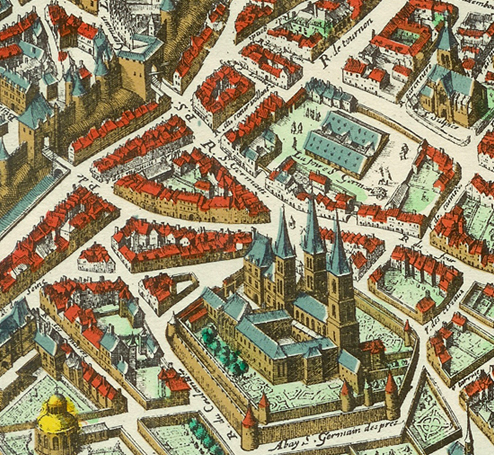
Maps are also of limited use – the instinct of most map-makers has always been to tidy up mess, to create order where there was none. That said, our old friend the  Turgot map (a map no Parisian time traveller should be without), which shows Paris in the 1730s, conveys some sense of the crowded, higgledy-piggledy make-up of the island.

Detail of the Plan de Turgot. Are those bollards in front of Notre-Dame, or a polite row of pigeons? Via Atlas Historique de Paris.

We can see immediately in these images how different the architecture was to anything found in Paris today. If we want to go deeper and understand the feel of the place, accounts of contemporaries are perhaps the best tool, and those who knew the old Île de la Cité paint an evocative picture.

….Mud-coloured houses, broken by a few worm-eaten window frames, which almost touched at the eaves, so narrow were the streets. Black, filthy alleys led to steps even blacker and more filthy, and so steep that one could only climb them with the help of a rope attached to the damp wall by iron brackets…

Eugene Sue, from the novel Les mystères de Paris, published in 1843 (English translation at Project Gutenberg)

The island was characterised by the frequently awkward co-existence of religion and far less spiritual activity. Notre-Dame must have dominated this landscape and produced an even more powerfully awe-inspiring effect than it does today. Up until Haussmann’s renovations, the parvis of Notre-Dame (the square in front of the cathedral) was very small and filled with stalls selling religious trinkets and relics, meaning that the visitor would emerge from the labyrinth of streets surrounding the cathedral (themselves dotted with many other churches, destroyed in the Revolution) and find themself staring almost directly up at the immense towers. The space in front of the west door would often witness the spectacle of condemned men and women begging for God’s mercy, before being taken to the Place de Grève to be burned or broken on the wheel. This served as an unwholesome reminder that lurking in the not inconsiderable shadow of Notre-Dame was a notorious den of thieves, murderers and criminals of every other shade – a late 16th century visitor even described prostitution being conducted in the cathedral itself. Parts of the island were practically off limits to police, and many an unwary pilgrim must have wandered haplessly into trouble.

Also dragging down the neighbourhood was the infamous Hôtel-Dieu, a hoary old hospital, in the loosest sense of how we comprehend the word, that had been in existence since the 7th century. Both sanitation and beds were always in short supply at the Hôtel-Dieu. Startlingly, in the 17th century around a third of all Parisians met their ends in the hospital, and by the time of the Revolution 3 or 4 people were often crammed into one bed.

The old Hôtel-Dieu, from the priceless series of photographs taken by Charles Marville before Haussmann’s work began.

No doubt the Île de la Cité possessed certain piquant charms, and must have been, one way or another, among the livelier parts of the city. Baron Haussmann himself was said to have been frequently found poking around its alleyways in his student days. But Haussmann never allowed sentimentality to stand in the way of a good wrecking ball, even wiping the street where he was born off the map. And the Île de la Cité was precisely the sort of place Napoleon III and his attack dog Haussmann were so keen to erase from the story of Paris. It was dangerous, dirty, uncontrollable and, worst of all, it was a clot in the arteries of the city, preventing the free movement they believed was so central to making Paris the city of the future.

The view from the towers of Notre-Dame, before Haussmann.

I’ll be looking more closely at the motivations of Napoleon III and Haussmann more closely in some future posts, here I’m more concerned with the effects of their changes. The Hôtel-Dieu was demolished and moved to a new building across the river. The parvis of Notre-Dame was cleared and expanded, creating the huge open square we see today. In general, as was the case with much of Haussmann’s schemes, the decluttering of the island opened up a multitude of spectacular views of the cathedral, which became more of a focal point of the centre of Paris than it had been before. So much residential housing was destroyed that the island’s population dropped dramatically. In a delicious and certainly intentional piece of irony, the rat’s nest of crooked, impenetrable and crime-ridden streets were replaced with the city’s central police station.

The Quai des Orfevres and Pont Saint-Michel, before and after Hausmann, again by Marville, via Le Figaro.

From this time forward, the Île de la Cité ceased to be a place to live and became part tourist mecca and part throughfare – a means by which Parisians could quickly traverse the Seine. Many histories of Paris ruefully describe the island of today as an empty, barren place with no life of its own. Sitting at a distance, leafing through a book, it’s easy to agree with them, and to mourn the loss of the ancient soul of Paris.

But when I think back to the times I’ve spent on and around the Île de la Cité, I can’t remember feeling sad or empty. Perhaps there is a slightly chilly, formal feel to the place, but it’s still more beautiful than most cities in the world could ever dream of being. There’s still the magnificence of Notre-Dame itself, standing out so resplendantly in every view across the river, buttresses flying in formation, towers standing firm and defiant. There are still the ancient ruins tucked away in the crypt underneath the parvis – one of the least known highlights of Paris tucked inconspicuously directly beneath one of the best. There’s still the quintessiantially Parisian experience of strolling through the pretty flower market near the Cité metro, the Conciergerie prison, whose most famous inhabitant was Marie Antoinette, the breathtaking elegance of Saint-Sulpice (last remnant of the Capetian palace that once stood on the island).

So somehow, through repeatedly and savagely destroying itself, Paris has reinforced its identity. The idea of Paris has been created through a long series of conscious decisions and many rewrites, creating the commercialised, packaged and glossy product that is Paris today, but never entirely able to wipe out the layers of history that run through the city like lines in a tree trunk. Its mutilations and mistakes are what make it what it is – a fascinating, complex place that’s impossible to pigeonhole. It’s easy (and fun) to long for Lost Paris, Old Paris – the Paris that never was and always will be – but Found Paris, always waiting to be discovered and understood, is far more satisfying.

Posted in 19th Century, Lost Paris, Medieval, Paris, Uncategorized | Tagged , , , , | Leave a comment

The History Carnival: Coming to Culture&Stuff

I’m pleased to announce that in August, I’ll be hosting the 101st edition of the History Carnival, a peripatetic showcase of the very best in history blogging.

Do please send in your nominations – anything will be considered as long as it’s historical, on the web, and pretty gosh-darned fascinating. Whether you wrote it, or just stumbled across it, if you liked it I want to know about it. You have until the end of July to get your nominations in.

To submit a post, either contact me directly or use the handy form on the History Carnival website, where you can also find out more about the whole shebang. Looking forward to perusing your entries!

Posted in Uncategorized | Leave a comment

Lost Paris: The Arènes de Lutèce, the Surprising Roman Arena in a Sleepy Parisian Square

This week’s Culture&Stuff post is a little different in that, well, it’s not on Culture&Stuff. Instead, you’ll find it over on Atlas Obscura, a wonderful site I’ve rhapsodised long and hard about before. It’s a compendium of the odd, the quirky and the lesser-known, a global encyclopedia of extraordinary places with extraordinary stories.

I added the details of the Arènes de Lutèce, the reconstructed remains of a Roman arena, dating from Paris’s early origins as a Roman city known as Lutetia. And it’s still sitting bang smack in the middle of Paris and waiting for your visit. I chose to post it there rather than here because it seems a perfect match for the site’s mission to uncover lost treasures under our noses, and I for one think that this particular Parisian oddity is worthy of much more attention. Check out the listing (which, Atlas Obscura being a collaborative effort, may have been edited and added to by others by now) and see if you agree.

Posted in Historical Places, Lost Paris, Paris, Uncategorized | Tagged , , , | Leave a comment

Lost Paris: The Dark (and Dirty) History of the Parc des Buttes Chaumont

There are certain places in the world where sadness collects and seeps into the ground; certain gnarls, certain pockmarks, certain flaws that crept in during the formation of the face of the earth, which can never heal.

Here is a picture of one of them.

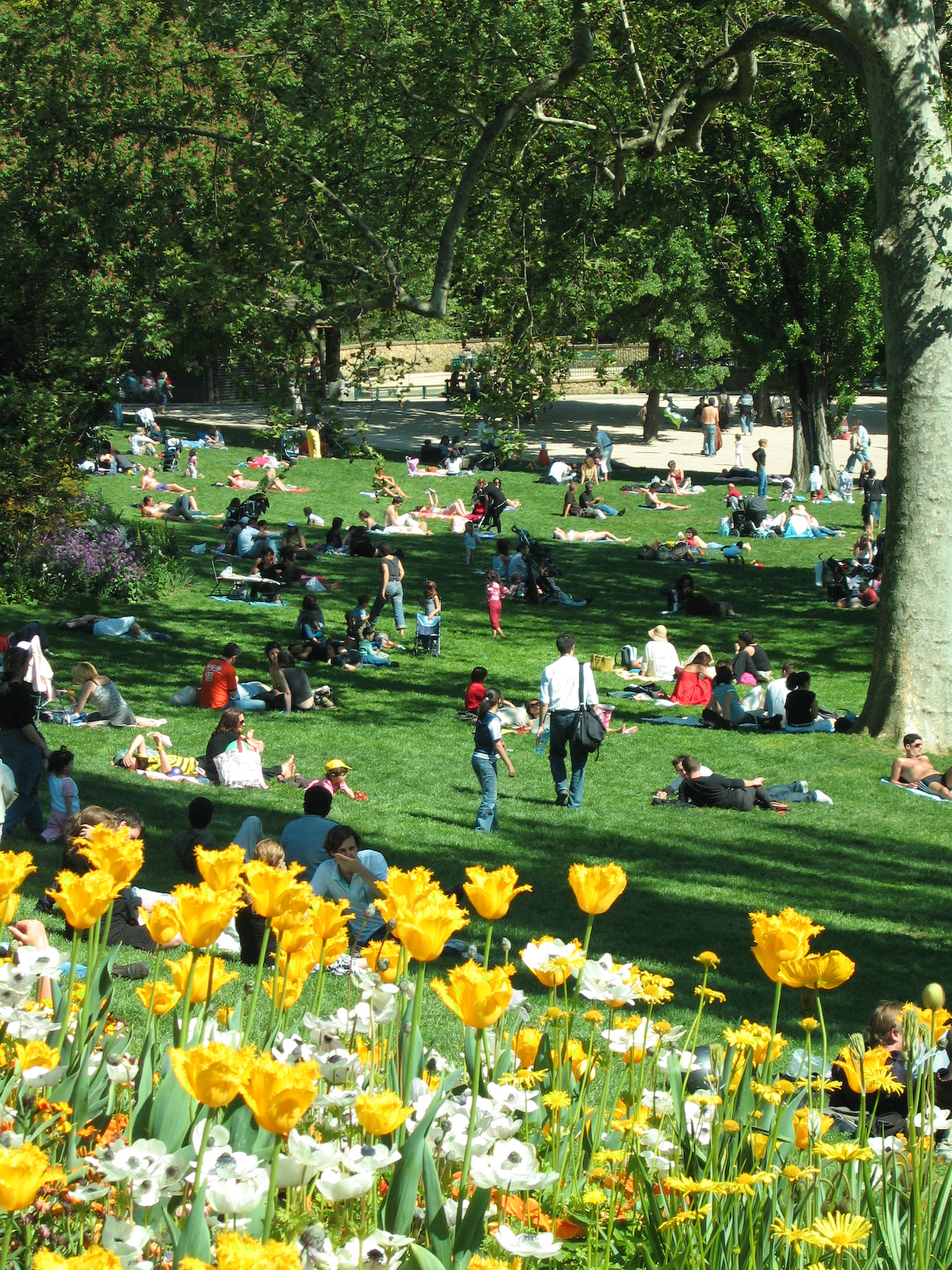
The Parc des Buttes Chaumont, by Jean-Louis Vandevivère via Wikimedia Commons.

Alright, the Parc des Buttes Chaumont may not look the part today. In fact, it’s probably my favourite park in Paris, and a beautiful spot for a peaceful picnic or a lazy afternoon in the sun. But don’t let appearances fool you – this place is a pretty strong contender for most godforsaken spot in all of Paris, historically speaking.

If you will get hung up on the visual aids, perhaps this one will help.

© Albert Harlingue / Roger-Viollet

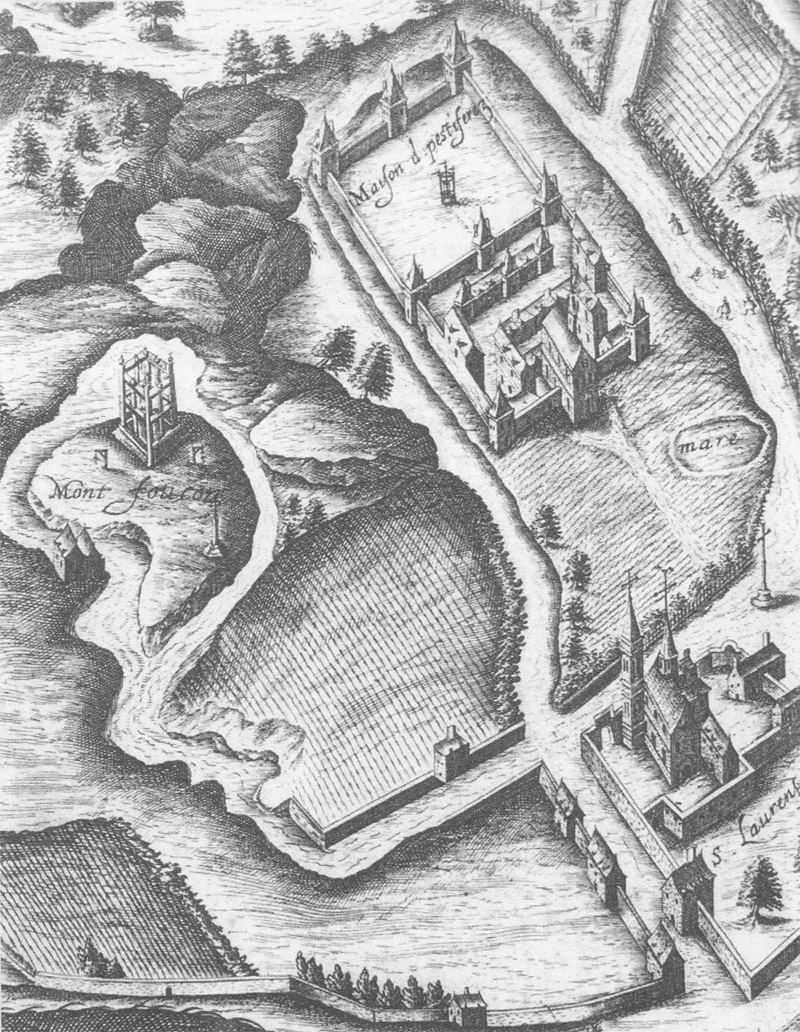
Now we’re talking. Something tells me this chap isn’t here for a picnic. For you see the Parc des Buttes Chaumont occupies the spot where once the infamous gallows of Montfaucon stood. First built in the early 13th century by Saint Louis, this proved such an excellent spot for a hanging that in the 1320s Charles IV demolished the rather amateurish gibbet that been used here, and replaced it with the blood-curdling monstrosity you see above – a 16 metre-high stone structure, allowing of course for more hangings but also for the more efficient display of the corpses of the executed. Situated on a prominent hill, the gibbet could be seen for miles around, and here lifeless bodies could be left for two or three years, bearing less and less resemblance to humanity as crows and wolves gnawed on their bones. As grisly as this warning to those considering a career in crime no doubt was, it doesn’t seem to have been particularly effective, because the gibbet didn’t finally close until 1627.

Montfaucon gibbet in the medieval period.

A bad start in life – you’ll concede – for this particular part of Paris, but a troubled adolescence perhaps, a prelude to happier days? Nope. Happiness would have to wait. The curriculum vitae of this area reads like a descent through the seven circles of hell. First it became a dumping ground for all the ripe sewage of Paris. Then it graduated to a life as a knackers’ yard, where in good years 15,000 unfortunate horses could be sent to meet their makers. The sinister efficiency of Montfaucon meant that these frightening activities spawned horrifying sub-industries of their own. The sewage was processed into a fine powder and sold to gardeners, who sprinkled it over their tulips. The horse hides were sold to tanners (whose own foul stench was legendary), and the festering horse guts were used to breed maggots for fishing.

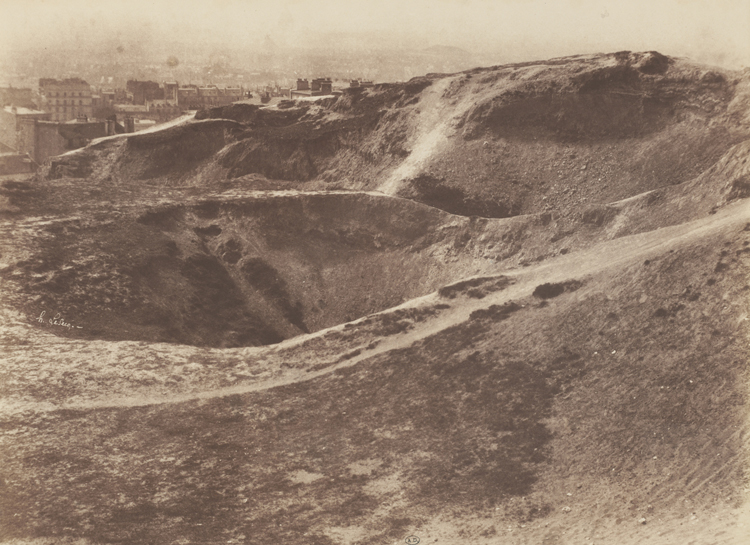
Miraculously, beneath these layers of filth were found deposits of beautiful white plaster of Paris, so tunnels were driven deep into the ground, adding further to the pock-marked, extra-terrestrial effect of the landscape. Gangs of thieves and bandits soon occupied these tunnels (as they seemed to do in any space left open in Paris for any length of time – like a liquid flowing to fill its container).

The area in 1852, in a photograph by Henri Le Secq.

It’s a mark of the breathtaking audacity of Napoleon III (who was an ardent admirer of London’s great open parks and longed to bring the idea to Paris) and Haussmann that they looked at this terrible place, with its toxic history, and decided to reverse it at a stroke. The gouges in the landscape would make perfect lakes for boating and a romantic grotto, and the area’s natural elevation could be used to display not rotting corpses, but a picturesque temple. And so, in the 1860s, the Parc des Buttes Chaumont was engineered, and history was, quite deliberately, wiped out.

But a past this dark refuses to release its grip without a fight. When the light-headed dreams of Napoleon and Haussmann came crashing down, violence very quickly returned to the Parc des Buttes Chaumonts as in 1871 Communards occupied the park until the government shelled them into submission from the heights of Montmartre. And even today, one of the bridges leading to the temple is referred to, with chilling casualness, as the ‘suicide bridge’.

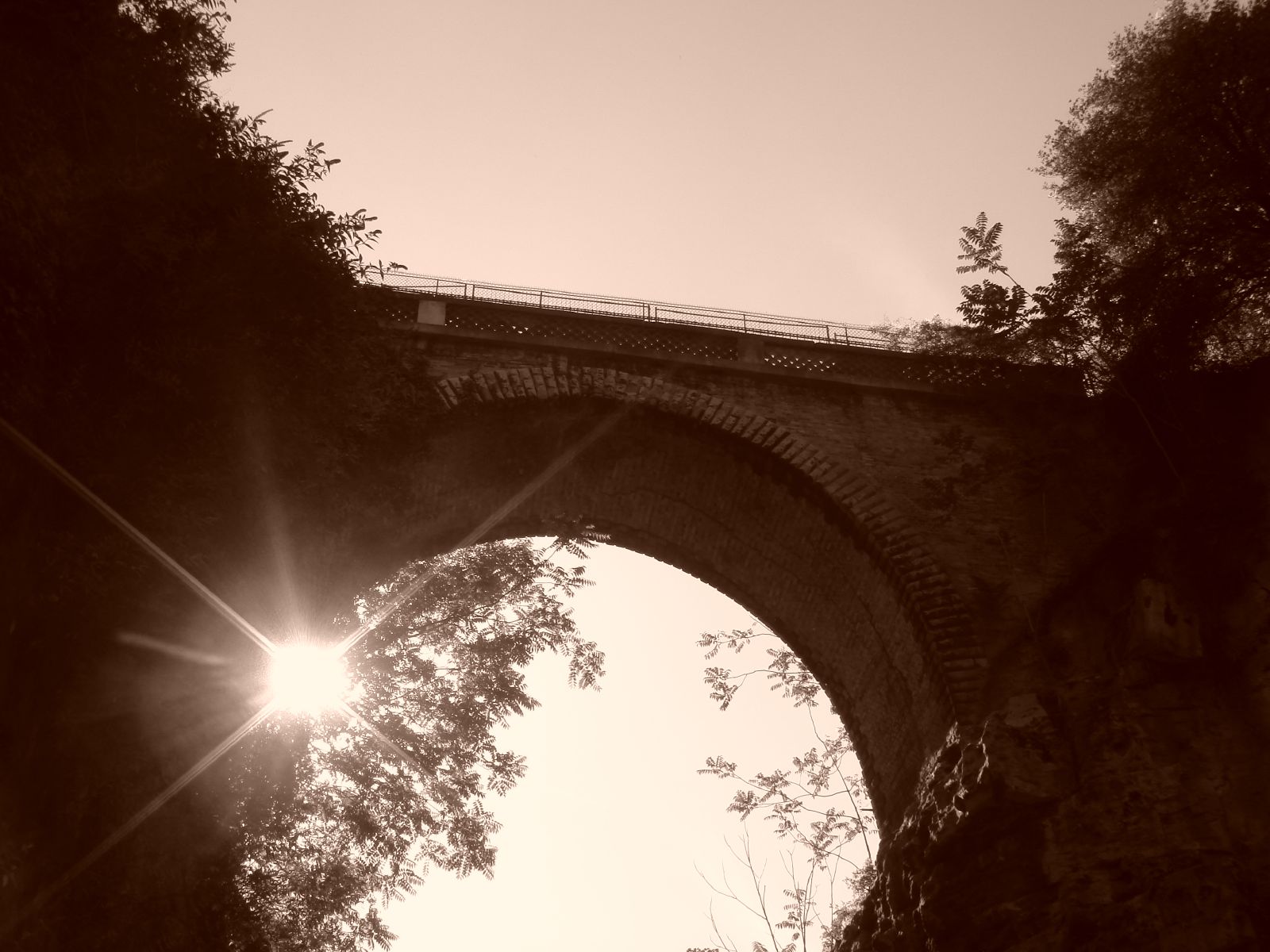
The ‘suicide bridge’, by austinevan via Flickr.

I don’t believe in the concept of evil, and of course the idea of curses is thoroughly alien to serious history. But it’s hard to avoid the impression that some deeply ill fate hung over this place for much of its history. But then, it’s so beautiful now, such a delightful place for a stroll – there can’t really be anything sinister at work there, can there? Quick, another visual aid – happy thoughts, happy thoughts!

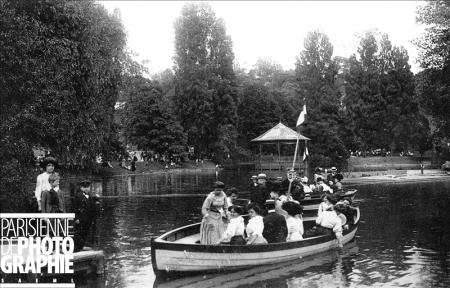
The park, in happier times. © Roger-Viollet

More

  • Paris: Biography of a City by Colin Jones This post is heavily indebted to this wonderful book – I’ve recommended it until I’m blue in the face. If you don’t have it, buy it.
  • Paris en images – a fantastic online resource for historical images of Paris, even if they charge for everything other than measly low-res images!
Related Posts with Thumbnails
Posted in 17th Century, 18th Century, 19th Century, Historical Places, History, Lost Paris, Medieval, Paris | Tagged , , , , , | 5 Comments

  • History Blogs - Blog Catalog Blog Directory Best History Sites on the Web